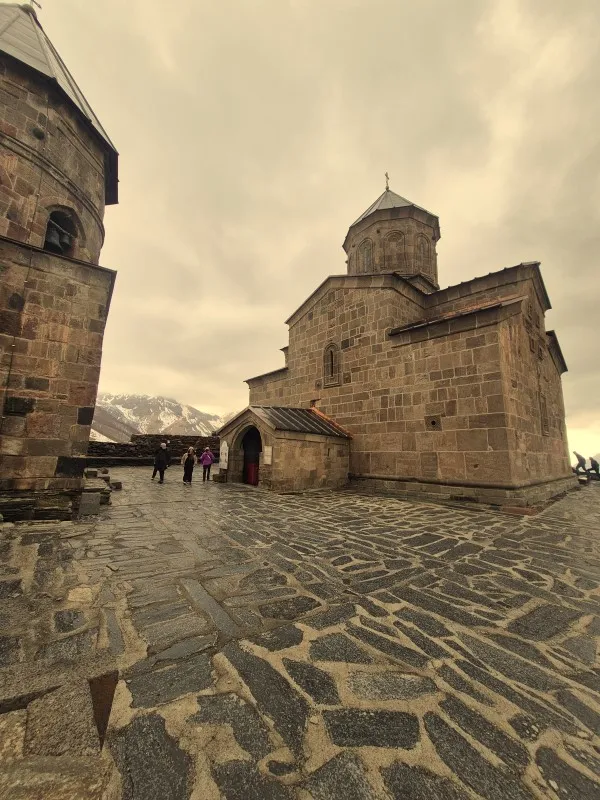
Perched on a dizzying limestone ridge 2,170 meters above sea level, directly beneath the frozen volcanic crown of Mount Kazbek (5,054 m), Gergeti Trinity Church (Gergetis Tsminda Sameba) is far more than an iconic postcard image. It is the spiritual citadel of the Khevi province—an impossible achievement of 14th-century masonry standing defiant against violent blizzards, ravaging imperial armies, and the sheer vertigo of the Dariali Gorge. For Georgians, this solitary sanctuary is not merely a place of worship; it is the ultimate metaphor for national resilience: a house of God built closer to heaven than to earthly kings.
The Secret Vault of a Kingdom Under Siege
Built in the 1330s during the golden twilight of the unified Georgian Kingdom under King George V “the Brilliant,” Gergeti Trinity Church was deliberately conceived as both a monastery and an impregnable mountain safehouse. Throughout Georgia’s turbulent history, whenever Mongol hordes, Persian conquerors, or Ottoman invaders burned the royal capitals of Mtskheta and Tbilisi to the ground, the country’s most venerated treasures were quietly gathered by loyal monks and carried up through the treacherous Dariali cliffs to Gergeti.
Here, guarded by the fiercely independent mountaineers of Khevi—who answered to no feudal lord but God alone—lay Saint Nino’s sacred Grapevine Cross, the ancient icon of the Virgin of Khakhuli, and the chronicles of medieval kings. Protected by sheer vertical precipices and relentless snowdrifts that cut off access for eight months a year, Gergeti served as an impenetrable vault. In times of national catastrophe, the soul of Georgia was preserved on this single, windswept ridge.
From Pagan Sanctuaries to Pushkin’s “Monastery in the Clouds”
Long before basalt stones were chiseled into Christian cross-cupola arches, this windswept cliff was already sacred ground. Ancient Khevi pagan cults revered this summit as a bridge between earthly mortals and the celestial spirits of the glaciers. Even today, a close look at the weathered masonry reveals subtle carved relics of that archaic world: mysterious astronomical wheels, Celtic-like solar discs, and stylized animal totems quietly woven into the Orthodox stonework.
Centuries later, this mystical isolation captured the imaginations of Imperial Russian writers exiled to the Caucasus. In 1829, Alexander Pushkin traversed the Georgian Military Road below, looked up toward the floating sanctuary through swirling mists, and penned his famous ode to the monastery:
“Monastery on the high mountain! / Hidden beyond the clouds, / Your cell shines like an ark floating in the sky…”
Later, during the Soviet era, when the bells were forcibly silenced and atheism reigned, the sanctuary survived against all odds. Today, monastic life has returned. Wandering into its candlelit nave beneath blackened vaulted arches, where ancient stone still breathes the scent of melting beeswax and wild alpine incense, travelers enter a world that modern centuries have failed to touch.